Showing posts with label gyn cancer. Show all posts

Wednesday, March 8, 2023

March 8, 2023 Open Mic and 100th Chat

What better day than International Women's Day to celebrate our 100th Chat. We had fifteen participants join us. You may find our transcript here and additional analytics here.

We began the chat by sharing our updated logo.  

The colors now reflect more gynecologic cancer awareness colors. 

We shared how #gyncsm chat sessions have been used in three different journal articles. You can view links to these as well as links to articles that reference cancer hashtag communities on our blog's  Publications page: gyncsm.blogspot.com .

Next we talked about our chat topics through the years. Check our Chat Topics page (http://gyncsm.blogspot.com/p/chat-topics.html) on our blog to see other topics. Here are three chats mentioned. 


"#gyncsm re use of symptoms; important of course for early care advocating for work up but it is important re nuances also bc many pts coming blaming themselves for not knowing or coming in earlier when sometimes not be possible. I liked this summary,"


Two participants shared projects or campaigns they are working on. 

We closed our chat in the usual way asking for TIL "Today I learned" and @gyncsm began by sharing:

There is no chat in April but Save the date for our next #gyncsm chat on Wednesday, May 10th, at 8pmET to talk about “Urogynecology and Pelvic Health”. 

Dee

Friday, March 3, 2023

Open Mic and 100th Chat March 8, 2023


Christina and I are happy to invite you to #gyncsm's Open Mic and 100th Chat on Wednesday March 8. 2023 at 8pm ET. It seems like only yesterday when together with three gynecologic oncologists, Drs Dizon, Markham, and Boulay, we held our first chat in September 2013. 

To celebrate our 100th chat, we updated our logo.  


We've added three intersecting ovals (teal, peach, purple) to represent the intersection of those impacted by different gyn cancers into one community.

We thank each and every guest host and health care provider and researcher for providing important information to countless patients, survivors, advocates and caregivers through these chats. Our topic list is lengthy, but we focused our chats on the gyn cancers and their risks, advocacy, caregiving, quality of life, clinical trials, research results, news from medical conferences, genetics and personalize medicine, emotional and physical support, survivorship issues, recurrence, and how to work best with your doctor. Have a look at them all here.

On Wednesday we will open the floor to questions from this broad community in this 8th edition of an "Open Mic" chat. 

What's on your mind? 

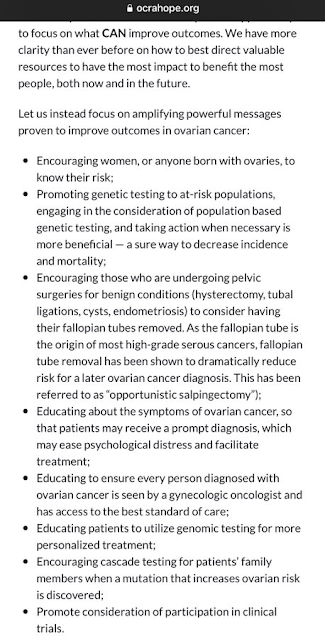
  • Do you want to discuss OCRA's  recent consensus statement on fallopian tube removal to reduce risk of ovarian cancer? Or how to participate in OCRA's program free genetic testing program? 
  • Do you want to share your experience in a clinical trial? Or how to discuss clinical trials with your doctor?
  • Do you want to discuss the latest research in treating endometrial cancer?
  • Do you want to know what you can do to improve equity of treatment?  
  • Do you want to discuss the  use of mirvetuximab soravtansine-gynx, Elahere,for women with recurrent ovarian cancer? 
  • Do you want to know if others are experiencing QOL issues like yours? 
  • Do you want to discuss low-dose aspiring use for ovarian cancer risk reduction? 
  • If you are a health care provider, do you want to know where your patients get information? 
  • Do you want to talk about getting involved in advocacy? 
 
What better day to join with other patients, survivors and health care providers that on International Women's Day. We hope to see you on Wednesday. 

Dee and Christina
#gyncsm co-foudners

Wednesday, August 11, 2021

August 11, 2021 Cancer Myths

This month we came together to discuss Cancer Myths. Twenty-six participants joined us for this important discussion. You may find analytics here and a transcript here. 

Here is a sample of the responses to our topic questions. 

T1: For you, what makes something a cancer myth? Is it strictly false information or is it something more?

  • I see the term "cancer myth" as a widely held belief about cancer. It could be true, false, misleading or anywhere along the spectrum. For me, it is a vague idea that I haven't really looked into the facts of
  • I think of it as misinformation that for whatever reason has persisted through time.
  • Sometimes people make generalizations ('cancer myths') about cancer, cancer treatments or cancer outcomes - but every cancer is different and every patient has an individual experience.
  • I think of cancer myths as outdated information or false beliefs that people have regarding cancer.
  • It may also be an assumption about the disease, or its treatments, that are taken for granted based up conventional wisdom, rather than evidence. When passed down by attendings to trainees, we called it #oncolore in my residency

T2: What are some cancer myths that you grew up with? What are some you have encountered as you've been impacted by cancer or worked with cancer patients? (re: causes/what happens during treatment/about emerging treatments/other)

  • Thinking back on my dad's cancer, I remember people talking about this idea that once you have surgery and expose it to air, you've allowed the cancer to spread and the end comes more quickly
  • People thinking there is a cure for cancer and it’s being hidden from us, sigh 😣🙄. Cancer isn’t one disease. People don’t realize it’s many diseases.
  • “Cancer is a death sentence”, “Sugar fuels cancer”, “You are too young for cancer”, to name a few.
  • I think “cancer = death sentence” is a belief/response that can be important to unpack and surround w/the individual facts at hand. Some cancers do have little progress - others certainly not as much as we would like - but there are ways to provide hope along w/info
  • A cancer myth I still occasionally hear is "you can only inherit female cancer risks from mom" ... We all inherit DNA from both mom and dad, hereditary cancer risks included! Both sides of family health history are important #gyncsm #FamilyHealthHistory #GeneticsMyths
  • Growing up - The myth that only old people got cancer. Most recently - The myth that my HPV cancer was directly my fault. #gyncsm

T3: What are some cancer myths that come up around nutrition/diet? Why do you think there is so much conflicting information in this area?

  • the top myth to me is - People who have cancer shouldn't eat sugar, since sugar makes cancer to grow faster. All cells, including cancer cells, depend on blood sugar (glucose) for energy. Giving more sugar to cancer cells doesn't make them grow faster.
  • And artificial sugars too. So no sweets for anyone lol. #gyncsm
  • I think people want to believe that you have some control over whether you get cancer so thinking that if you eat healthy, limit sugar, and exercise, you will be safe which is not always true
  • Agree - The risk of focusing on areas we can "control" is the inevitable opposite, that when something out of our control happens, there is shame/blame... Feels similar to fad diets and other trends that seem to just make people feel bad about their bodies
T4: Are there cancer myths specific to gynecologic cancers? Is there information you learned about a gyn cancer that you now know is wrong?
  • Maybe not a myth, but there is a lack of basic female anatomy knowledge and also many do think the pap covers “everything down there” vs mainly cervical cancer.
  • In the #sarcoma world, some women assume a PAP smear will catch their cancer. Not necessarily.
  • There are absolutely myths to GYN cancers. One is that cervical cancer is the “easy” cancer, that it is just bad cells from a Pap test when in reality it is much, much more involved.
  • that the Gardasil vaccine will cause fertility issues or other catastrophic problems.
T5: What are some tips for handling cancer myths and responding (or not) when you encounter them - both in-person and online?
  • Tell people to fact check and look for information that is factual and not hearsay. As frustrating as it is at times, some people just can’t hear you.
  • I try to educate in a calm manner to dispel the belief. Can be quite difficult with some people though. It’s important to remember you may not change their mind about some things and to stay composed
  • Very situational - have to adapt to the person and setting. First step I find helpful is active listening and clarifying where the perspective/myth comes from.
  • will ask the person to share the research that backs their statement. Then I share a reliable source or journal article that dispels the myth.
  • I often give people studies or quote experts. But I try to be diplomatic, unless I think the person is making money or hurting people with myths.
  •  Dispelling myths can take a lot of time and energy. And it is okay to not always be up for that. When we can interact one on one and ask questions IF they are open to a discussion that is where to start.
  • Meet people where they’re at - sometimes that’s really hard. Sometimes they are not taught what we already know. Clarify and ask questions to understand. Have a conversation. Share your story and some reliable resources for them to check out.
  • There is a ton of attention and research in health communication and combatting misinformation with ~everything~ going on...I look to experts in that space for ideas and approaches to build trust and communicate evidence clearly
  • I get an alert from Pubmed on new research for #leiomyosarcoma, including gyn LMS. I read experts online & attend #sarcoma conferences when I can afford them. 
T6: What are your go-to sources for reliable information about cancer? For gynecologic cancers specifically?

We look forward to you joining us at the next #gyncsm chat on Wednesday, September 8, 2021 at 8pm ET when we’ll discuss Genetic Testing and Gyn Cancers. We’ll also be asking our participants to fill out a survey to help us improve the #gyncsm community. 

See you in September for Gyn Cancer Awareness Month! 

Dee and Christina


Sunday, August 8, 2021

Cancer Myths #gyncsm Chat August 11, 2021


Patients and caregivers may hear from family and friends or see advice and information both online and in print about what causes cancer, cancer treatments and risk reduction. Some of that advice is good but some is inaccurate and others are false - yet the information continues to spread. We invite you to join us on Wednesday, August 11, 2021 at 8pm ET (7 CT, 5 PT) as the #gyncsm community comes together to discuss Cancer Myths and shed some light on where you can go to find reliable and accurate information.

We'll use the following Topic Questions (T#:) to guide our discussion:

T1: For you, what makes something a cancer myth? Is it strictly false information or is it something more?

T2: What are some cancer myths that you grew up with? What are some you have encountered as you've been impacted by cancer or worked with cancer patients? (re: causes/what happens during treatment/about emerging treatments/other)

T3: What are some cancer myths that come up around nutrition/diet? Why do you think there is so much conflicting information in this area?

T4: Are there cancer myths specific to gynecologic cancers? Is there information you learned about a gyn cancer that you now know is wrong?

T5: What are some tips for handling cancer myths and responding (or not) when you encounter them - both in-person and online?

T6: What are your go-to sources for reliable information about cancer? For gynecologic cancers specifically?


In preparation for our chat feel free to read this article from the Mayo Clinic. https://www.mayoclinic.org/diseases-conditions/cancer/in-depth/cancer-causes/art-20044714  . 

We look forward to seeing you on Wednesday, August 11th. 

Dee and Christina


Wednesday, May 12, 2021

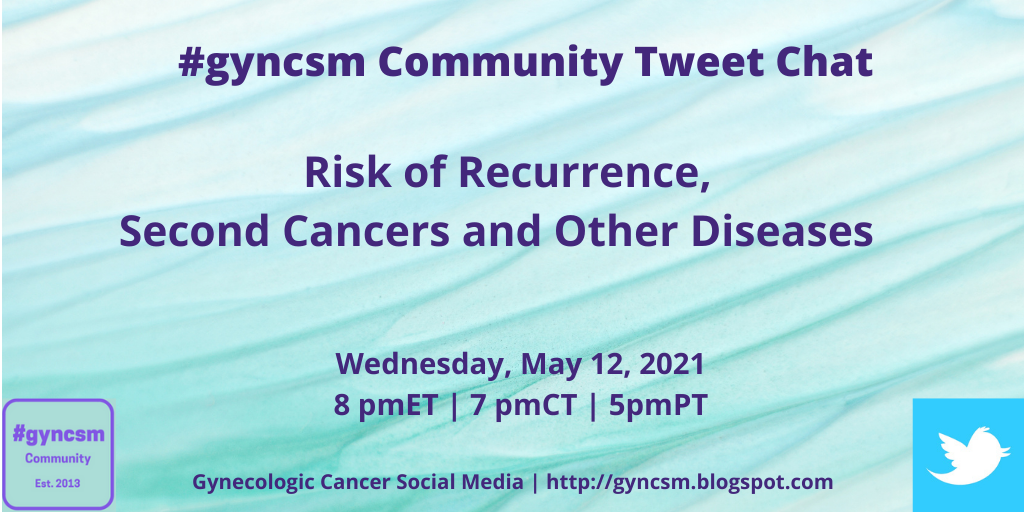
May 12, 2021 Risk of Recurrence, Second Cancers, and Other Diseases #gyncsm Chat

The #gyncsm community discussed Risk of Recurrence, Second Cancers, and Other Diseases for those diagnosed with a gynecologic cancer on May 12, 2021. We had twenty-six participants and 1.330 Million impressions - see more analytics here and you may read the transcript here.

Some highlighted Tweets from the chat may be found below each question. You will also find resources listed at the bottom of this post.

T1: What is the risk of recurrence for the main types of gynecologic cancer? Which gyn cancers have the highest recurrence risk?

  • According to @CancerCenter "An est. 35% of patients w/invasive #cervicalcancer develop persistent/recurrent disease following treatment. The recurrent cervical cancer rate is lower for those w/ early-stage disease. Most recurrences occur within 2 years of treatment."
  • The recurrence rate for #ovariancancer is very, very high. It can be hard to talk about with patients - and some don't want to think about it - but it also surprises too many that didn't get an open discussion after initial treatment 
  • Endometrial - recurrence rates for patients with early-stage disease range from 2–15% and reach as high as 50% in advanced stages or in patients with aggressive histologic condition. (70-100%) recurrences occur within 3 years after primary treatment from a 2011 study
  • vulvar cancer - Most recurrence occurs 2 years after treatment in women with inguinal lymph node involvement (32.7%) versus those without (5.1%). #gyncsm
  • Ovarian cancer has the highest recurrence rate overall -85% (occurring in 25% of patients with early-stage disease and >80% of patients with advanced disease.) 
  • There are many variables to consider (tumor stage & subtype, initial treatment, if there were tx breaks). For instance, cervical cancer is more likely to not recur if chemoRT is completed within 8 wks of starting.

T2: What is known about reducing one's risk of recurrence? How are cancer survivors monitored for gyn cancer recurrence?

  • Follow-up care is imperative for preventing recurrence of #cervicalcancer. That includes exams, imaging, and blood work. Exercise and diet may help along with smoking cessation.
  • I have heard that exercise may be beneficial in lowering one’s risk of recurrence
  • There are only so many things that one can control when trying to reduce risk. Some things we know - Find a way to be active that works for you. Stop smoking. Lots unknown. A long-term study in AZ was looking at eating, activity and more for ovarian cancer survivors.
  • While we all want to be in the group that never recurs, I think it's important to let people know the possibility. Nothing stops the shock of actual recurrence, & living in fear is hard - to be sure - but since it's likely with #ovariancancer, facts are important.
  • Survivorship plans are important for continued monitoring after initial diagnosis. The balance is listening to your body and getting things checked out without freaking out.
  • I know I was told very clearly by my first gyn Onc that I had no chance of recurrence, but here I am 4x later. I just hope everyone knows the possibility honestly. #gyncsm
  • T2 monitoring for recurrence: Regular exams; education about symptoms to report; routine imaging not always indicated but depends on individual plan; tumor markers if appropriate. Consuder for Surveillance plan - individual pros and cons/ patients preferences
  • I think survivorship plans are very important its been 10 years since my diagnosis and hardly any of my physicians followed mine because I had endometrial cancer they didn't think it was important after the hysterectomy. If only they knew 
  • Kind of back to preventing recurrence. But what treatment we get initially, if we have a gynonc (or not), & what type of surgery can all matter as well.
T3: Many cancer survivors report that fear of recurrence impacts their survivorship. What are some tips for dealing with the fear of recurrence?
  • We have so many great nuggets of advice on our blog (search for recurrence). A few are "Know your existence," "Own your story," Set boundaries, ask for help, journal it out, and take care of your mental health. https://t.co/25m45zv2WD #cervivor
  • walking my dog always keeps me chill & works for me…. We both enjoy it
  • There are some good resources - videos, podcasts, literature - about dealing with the fear of cancer recurrence because so many experience it. Know you are not alone. #gyncsm one via @CancerDotNet https://t.co/aFzmrUlrrP
  • Latino cancer survivors face a tough journey. Our leader, Dr. Amelie Ramirez of @UTHealthSA, is helping launch a 6-year @theNCI study to find new ways to help Latino cancer survivors heal, recover, and stop cancer from returning!
  • I think the most important thing is to show those of us who LIVE with multiple recurrences and still make a positive impact and have a happy life! It’s tough, but I’m much better off than those frozen in fear! 
  • Incredibly important to address! Any plans for education and surveillance we add as MD we should be recognizing how this creates anxiety! and really should be coupled with how to get resources on coping, normal expected anxiety...
  • Here is the facebook page for Survivor Slimdown https://t.co/tVeEbxSI3N
T4: What are some of the secondary cancers that those with a gynecologic cancer should be concerned about? What is the role of genetics and family history? What about secondary cancers related to treatment?
  •  We can still get cancers that others get. According to @AmericanCancer, #cervicalcancer survivors are at higher risk for: mouth/throat, larynx, anal, vulvar, vaginal, lung, bladder/ureter, stomach, colorectal, pancreas, and acute myeloid leukemia.
  • As we learn more and more about genetics, we learn more about what caners are connected and run in families. Know your family history if you can. See if multi-gene testing is advised as more is known.
  • From @EKing719 in women who have had Hpv-related gyn malignancies there is a risk of anal cancer . Check @FarrahFawcettFN https://t.co/DPVvvpaqzF and at https://t.co/bheTVoAKCu
  • There have been conflicting study results but generally we don't think that radiotherapy increases your risk of rectal cancer for instance. In rare instances, you can develop sarcoma about 10 years after radiotherapy.
  • for basics also making sure survivors keep up with screening depending on phase in cancer care and age re #breastcancerscreening #colorectalcancerscreening #lungcancerscreening // know family history// refer for genetic counseling!!
  • those of us with genetic mutations have to deal with risk of getting yet another cancer and decisions on how to prevent that
  • HNPCC or Lynch Syndrome While HNPCC poses the greatest risk of colorectal cancer, women with HNPCC have about a 12 percent lifetime risk of developing ovarian and a 40-60 percent chance of developing uterine cancer.” https://t.co/QbGQXoXRD5
  • Ran across this while doing chat prep: Meta-analysis and retrospective pharmacovigilance study of MDS and AML in patients receiving PARP inhibitor treatment https://t.co/LXHXHi7T6K
  • It can be heavy to talk about all the additional risks, but like someone said, knowledge can help one deal with the fear and not be blind-sideded if something does come up.
  • Very important point! Important to know for patients who on your medical team can best help quarterback getting appropriate tests scheduled, ordered up to date etc- sometimes gyn onc or med onc or PCP or cancer genetics team . @FacingOurRisk - great resources here!
T5: Are there other physical and mental health conditions that being diagnosed with and treated for gynecologic cancers increase the risk of experiencing?
  • many already have a list of conditions prior to cancer. This just adds to the pile. Can be hard to assess what is causing what.
  • PTSD is often experienced in our community from internal radiation. It may take someone years to process through the emotional toll - as for physical, there are various side effects from lymphedema, infertility, osteoporosis, gastrointestinal issues, etc.
  • For women who were younger who went into surgical menopause due to surgery, this can create many physical & psychological issues.
  • Issues related to sexual function; chronic changes in urinary and GI function after surgery, chemo and or RT.; early referring to physical therapy, urogyn, GI nutrition.... need to ask and talk about even if no easy answers.
  • In my own situation it has increased my anxiety and depression at times especially in regards to my infertility.
  • Confounding this is that the rate of #ovariancancer is higher in those who have had #PTSD prior to diagnosis. And, we know from the #ACEs study, those of us with trauma in childhood have increased risk of many diseases, including cancer.
  • one of my concerns are potential cardiac issues due to cancer treatment combined w surgical menopause.
T6: What impact does having had cancer have on risk for and severity of COVID-19 and other non-cancer related diseases?
  • Most research shows that having cancer increases your risk of severe illness from COVID-19. Other factors include a weakened immune system, older age, and other medical conditions.
  • you can find resources at @GYNCancer site https://t.co/fvRX6dpubK

We end our chats with Today I Learned (TIL) . Here is a TIL from tonight's chat. 
TIL: Hard conversations are... hard. But let's not avoid them. Cancer stories are not all "inspirational/positive" but they are all important and provide so much value. Thanks to all who share their cancer truths.

We look forward to you joining us at the next #gyncsm chat on Wednesday, June 9, at 8pmET (new time for 2021) when we’ll discuss “GYN Cancer Research News” from #SGOMtg and #ASCO21

Dee and Christina
#gyncsm Co-Founders
 

Resources 
@AmericanCancer - Can I Do Anything to Prevent Cancer Recurrence?
https://www.cancer.org/treatment/survivorship-during-and-after-treatment/understanding-recurrence/can-i-do-anything-to-prevent-cancer-recurrence.html

HealthDay - Obesity And Overweight Associated With Increased Risk Of Developing Several Types Of Cancers 

@sloan_kettering MMSKCC - 6 Tips for Managing Fear of Recurrence

Meta-analysis and retrospective pharmacovigilance study of MDS and AML in patients receiving PARP inhibitor treatment  

Ovarian Cancer Patients at Higher Risk for Mental Illness  


@GYNCancer - Covid resources

Post-treatment surveillance and dignosis of recurrence in gynecologic malignancies - SGO recommendations  

American Cancer Society - Second Cancers after Endometrial Cancer 
 
@CancerDotNet - Heart Problems

Thursday, May 6, 2021

Risk of Recurrence, Second Cancers and other Diseases 5/12/21 Chat


This month on Wednesday, May 12, 2021 at 8pm ET, the #gyncsm community will discuss Risk of Recurrence, Second Cancers, and Other Diseases among those diagnosed with a gynecologic cancer. 

Recurrence can be a tough subject that sometimes isn't adequately addressed following initial diagnosis and treatment. Yet, depending on the stage at diagnosis, we know that recurrence is an issue survivors deal with frequently. We will discuss what is known about reducing the risk of recurrence, monitoring for recurrence, and addressing the impact of the fear of recurrence. The risk of second cancers, especially for those with a genetic risk, will also be discussed along with the risks of other health conditions that can come with treatment for gyn cancers. We will finish our chat discussing the impact of Covid19 infection and other illnesses among women with a gyn cancer, including mental health issues.

We will use the following Topic Questions (T:) to guide our discussion:

T1: What is the risk of recurrence for the main types of gynecologic cancer? Which gyn cancers have the highest recurrence risk?

T2: What is known about reducing one's risk of recurrence? How are cancer survivors monitored for gyn cancer recurrence?

T3: Many cancer survivors report that fear of recurrence impacts their survivorship. What are some tips for dealing with the fear of recurrence?

T4: What are some of the secondary cancers that those with a gynecologic cancer should be concerned about? What is the role of genetics and family history? What about secondary cancers related to treatment?

T5: Are there other physical and mental health conditions that being diagnosed with and treated for gynecologic cancers increase the risk of experiencing?

T6: What impact does having had cancer have on risk for and severity of COVID-19 and other non-cancer related diseases? 


We hope you can join us,

Dee and Christina


Thursday, December 8, 2016

December Chat - Getting Involved in Research Advocacy (12/14)

In the past our community has chatted about advocating for yourself and others and about being a gyn cancer advocate. This month on Wednesday, December 14 at 9pmET (8pmCT/6pmPT) we would like to extend the advocacy topic to include how those impacted by a gynecologic cancer can become involved in cancer research and become a research advocate.

Our guest this month will be Elda Railey (@RANAdvocate) from Research Advocacy Network (RAN). You can read more about Elda, a founder of RAN, here.

We invite all those who are already research advocates and all those who want to learn about getting involved with research and becoming a research advocate to join the discussion, which will be guided by these topic questions:

T1: Beyond enrolling in clinical trials, what are some of the ways people can get involved with cancer research?

T2: How can patients and advocates keep up with research? What resources are out there to help us better understand the science?

T3: What does being a "research advocate" involve? How has this role changed as overall patient influence has grown?

T4: How can people start to get involved with grant review, clinical trials design, research dissemination, and/or conferences?

T5: What are some tips when it comes to reaching out to Congress about cancer research? What has shown to be effective?


In addition to the resources found on the Research Advocacy Network site you may also visit the AACR website's page on Becoming a Advocate for Medical Research.

We look forward to seeing you on the 14th for our final chat of 2016.

Dee and Christina
Co-founders #gyncsm Community

Thursday, November 17, 2016

Our Community - 2016 Survey Results

During September and early October we conducted a #gyncsm community survey. We were so pleased that 84 individuals took our survey. This is up from 37 respondents who completed our 2014 #gyncsm survey. We very much appreciate those who took the time to share their ideas and recommendations. Below are some highlights of the results.
 

The majority of survey respondents were Gynecologic Cancer Patient / Survivors (70.0%) followed by High Risk Individual or Advocate / Previvor (12.5%), Health Care Provider (11.25%), Caregiver / Loved One of a gynecologic cancer patient / survivor (10%) and lastly Cancer Researcher (5%).

The patient / survivor breakdown was:

  • 46.8% ovarian
  • 34.3% endometrial/uterine
  • 14.0% cervical
  • 8% fallopian, primary peritoneal, vulvar or GTD
  • 0% vaginal
  • 7.8% breast
Of the health care professionals who filled out the survey, the majority were nurses (42.8%) or gynecologic oncologists (28.5%). The remaining health care professionals were medical oncologists, radiation oncologists, researchers or genetic counselors.
 

We were interested in how followers interacted with the #gyncsm hashtag, chats and community. 43% of the respondents read the chat blog posts, 43% retweeted using the hashtag, 36% took part in a chat, 38% tweeted using #gyncsm, and 27% read a chat transcript. Less than 10% of the respondents joined us on Smart Patients platform. When asked specifically about our blog site, we found that 50% of the respondents visited our blog.

We asked which of the topics covered over the past three years were most important and these were the top five topics for survey respondents:

  1. Survivorship
  2. Advocacy
  3. Side Effects
  4. Personalized Medicine
  5. Clinical Trials and Support

When asked how they used the information from #gyncsm chats after the chat, the top response was advocating for themselves or others (58%). Also of note, 29% took part in an online support group and used a resource found in our blog posts. 


When we asked how we can better help the community and what topics we should discuss, here's some of what we learned:
  • Sometimes the time is either too early or too late.
  • Sometimes the chat is too quick for a meaningful discussion.
  • We should highlight other gyn cancers - endometrial/uterine, cervical were mentioned in particular. Continue to talk about clinical trials and genetics.
  • Talk about health care disparities and outcomes for women of color.
  • Talk about dealing with grief from the loss of friends.
  • Talk about sexuality after treatment.
  • Talk about what is important to younger patients.

We also asked respondents to share their thoughts on our #gyncsm chat/community and how it has has impacted their attitude toward their own health. Some of the things we heard are that #gyncsm provided:
  • Hope.
  • Made me feel part of the community.
  • Encouraged me to take more ownership in my own preventive health and advocacy for others.
  • Appreciate the range of resources offered.
  • Feel more empowered, less alone.
  • Led me to follow up more on some of my side effects and secondary challenges.
  • Wish #gyncsm could be leveraged into a new non-profit for all GYN cancers.
  • I felt like I was alone... there were no support groups near me. #gyncsm made me feel a part of a community.
But we also heard:
  • It is challenging for the hashtag to cover both advocacy/activism AND patient/survivor support - this is a common problem with other disease hashtags.
  • There needs to be more equal support for other cancers.

Lastly we wanted to know how individuals find out about #gyncsm. Respondents found us via:
  • Twitter
  • Other cancer chats
  • Facebook
  • Dee's Blog
  • From a friend
  • Researching cancer
  • Followed @btrfly12
  • NED twitter handle
  • Randomly found the #gyncsm chat
  • Smart Patients

Thank you to all who took this survey and for your continued support. We are using the information from the survey as we make our plans for next year. Remember if you have any other comments or concerns feel free to reach out to gyncsm@gmail.com.

Dee
#gyncsm Co-founder

Thursday, September 1, 2016

Awareness and Advocacy - Sept Round-up


Awareness months are a wonderful opportunity to build momentum around a health cause. Here are lots of resources and information about the great things you can get involved with for Gynecologic Cancer Awareness Month and Ovarian Cancer Awareness Month. We'll add to this post as the month goes along. You can also check out our RESOURCES section for overall and cancer-specific organizations and resources that are helpful year-round.

Gynecologic Cancer Awareness Month

Foundation for Women's Cancer
Cervivor (Cervical Cancer Awareness Month is January, so love seeing them join along)
  • Main Hashtags: #gcam #gyncsm #preventcc 
National Cervical Cancer Coalition (Cervical Cancer Awareness Month is January, so love seeing them join along)
UK Organizations:
Virtual Events:
Places to Find Personal Stories:
Gynecologic and Ovarian Cancer Symptom Images to Share:

Ovarian Cancer Awareness Month

Presidential Proclamation - National Ovarian Cancer Awareness Month, 2016
http://go.wh.gov/ZkDRGY

Foundation for Women's Cancer
Ovarian Cancer Research Fund Alliance
National Ovarian Cancer Coalition
SHARE Cancer Support
  • Main Hashtags: #TealTuesday #ovariancancer #gyncsm
Virtual Events:
Places to Find Personal Stories:
 

Hereditary Breast and Ovarian Cancer Week (9/25-10/1) and Previvor Day (9/28)

FORCE


Christina Lizaso
co-founder #gyncsm

Monday, April 13, 2015

Survivor's Story: GTD and Me – A Story of Diligence, Persistence, and Grace

During the recent tweet chat (#CancerFilm) which took place during the viewing of the documentary the Emperor of All Maladies, Christina conversed with Katie Smith, who was diagnosed with GTD (Gestational Trophoblastic Disease). Gestational trophoblastic disease (GTD) is defined by the National Cancer Institute (NCI) as a group of rare diseases in which abnormal trophoblast cells grow inside the uterus after conception. Trophoblast cells help to connect the embryo to the uterine wall and help to form the placenta. GTD, in most cases, is benign but some cases may be malignant and spread to nearby organs. Please see the NCI site for additional information. We are pleased to have Katie share her story with our community. 


GTD and Me
A Story of Diligence, Persistence, and Grace

I was 28 years old in the winter of 2005.  I had a beautiful one year old son that my husband and I had waited on for almost four years, a new job, and was excited about possibly having more children in the future.  Little did I know my world was about to be turned upside down.

After having my son, my monthly menstrual cycles became quite painful.  But, I just attributed it to getting older.  I also began having a thick discharge, but attributed it to post nasal drip (I have horrible allergies and thought that was the culprit).  In February 2005, I went to the doctor about the painful periods and an ultrasound was performed.  The doctor saw something in my uterus, but stated it was a fibroid.  Traditionally, fibroids can cause intense periods so this made sense.  I was sent home.

The next month, I noticed that my “pregnancy nose” had returned.  You know – that ability to smell someone eating a cheeseburger in the neighboring town.  At that point, I got a little scared.  While I wanted more children, I wasn’t prepared to have one now.  When I took a home pregnancy test, it showed faintly positive.  So, off to my OB/GYN doc I went.

The blood pregnancy test indicated that I had been pregnant but had a miscarriage.  This was devastating!  According to the doctor, my HCG levels were low which indicated that there may still be remnants in the fallopian tubes.  I was given a very light dose of Methotrexate to help flush out any remaining items.  I was again sent home, but was asked to come back in a couple of days for another HCG level check.

But, when I came back a couple of days later, my HCG levels were starting to creep up.  I was asked to come back in two more days for another check.  This went on for about 1 ½ months (including a stronger dose of Methotrexate thrown in there).  For some reason, my levels would not go down.  At this point, my OB/GYN doctor became concerned.  She said, “I really don’t think this is cancer, but I want you to go see my doctor.  He is a Gynecological Oncologist who can rule out cancer and figure out what this is.”

Dr. Don Hall, the Gynecological Oncologist, immediately sent me for an ultrasound.  The Ultrasound Tech stated, “I see a fibroid in there.  That’s it.”  But, Dr. Hall had a feeling that this was more than just a fibroid.  After multiple urine and blood tests, along with a PET scan, the diagnosis was found.  While all of this was going on, I became engrossed in finding out what this could be.  I stumbled across a Gynecological Disease website and found something called “Gestational Trophoblastic Disease”.  The symptoms sounded like the ones I had been experiencing.  Could it really be cancer?

It was a Friday afternoon and I was called in for my results.  With my mother on one side of me and my husband on the other, Dr. Hall delivered the news.  I had a Placental Site Trophoblastic Tumor, which is in the GTD family of cancers.  Less than ½ of 1 percent of women have this type of tumor, and it forms where the placenta attaches to the uterus.  He had already scheduled my hysterectomy for the following Wednesday.  I would be in the hospital for 3 days and on leave for 6 weeks minimum.  I would have a long scar starting from my belly button down, and they may have to remove part of my intestine.  The PET scan had indicated the tumor had protruded through the uterus and was wrapped in the intestine.

Part of me was relieved to have a diagnosis but the other part of me was terrified.  In addition, our insurance was completely maxed out (this was in the day of annual maximum amounts and before the ACA).  We would have to pay for the entire surgery and any other treatments that I would have to go through.  Funny enough-I didn’t worry about the money part.  I just wanted to be alive to see my son grow up.

When Dr. Hall went in to do the surgery, he discovered that the tumor had not protruded but was fully contained in the uterus.  It was removed and sent off for growth rate testing.  If the growth rate was low, no further treatment would be necessary.  If the growth rate was high, I would have to take chemotherapy and radiation.  In addition, it was discovered I had really bad endometriosis and one of my ovaries was removed because it was badly damaged. 

The results of the growth rate testing showed that the tumor was growing at a slow rate.  However, I had to come back every month for HCG testing.  Each time I went it, I would get very anxious.  I had ghost symptoms constantly and stayed panicked.  But, the first year went by with no increase in HCG.  In July 2015, I will be 10 years cancer free. 

There is a very slight chance it could recur as lung cancer, with an even slighter chance of breast cancer occurrence.  But, thanks to God, the concern of my OB/GYN doctor Rebecca Walker and the diligence and persistence of Dr. Hall,  I’ve been able to experience 11 years of bliss with my son. 

What can you take from this story:  Listen to your body.  It will tell you when something is wrong.  If something is wrong, don’t blow it off.  Have it checked out – it might just save your life.

- Katie Smith (@katielizsmith)


Thank you so much Katie for sharing your story with us. 

Dee 
#gyncsm co-moderator