Showing posts with label patient reported outcomes. Show all posts

Wednesday, February 13, 2019

Getting Into a Clinical Trial - February 13, 2019

This month's chat, Getting Into a Clinical Trial, allowed our participants to learn from experts and our community to share resources which help patients find and decide on a clinical trial.

In addition to our health care moderators Drs Temkin, Westin and Becker-Schutte, we were joined by Dr. Christina Annunziata (@CMAnnunziata), Clara Health (@aaronjun_@Clara_Health), Clearity Foundation (@ClearityFnd), Lilly Trials (@LillyTrials) and Smart Patients (@RobinSmrtPtient, @smart_patients). Twenty-seven participants created 1.4 million impressions during the hour chat. You may find more analytics here.

Below is a sampling of responses to our questions. A full transcript may be found here.

T1: Before looking for trials, what information do patients need? What is helpful to consider/decide ahead of time?
  • T1 it's important to know your medical history before looking for a #clinicaltrial. Type of cancer, stage, prior treatment.
  • Clinical trials can work for women at any point in their #ovariancancer experience and should be considered along with standard of care. Physicians may not always suggest a trial. It's important to speak up and ask questions. Find out more at: https://www.clearityfoundation.org/clinical-trials-can-help/
  • Before starting to look for trials, it can be helpful to read about the differences between standard care and receiving treatment as part of a trial. We wrote a guide highlighting the differences here! https://guides.clarahealth.com/preparing-for-your-clinical-trial/
  • Every trial protocol is different, so knowing what matters in your trial search before you get started can help you narrow down the options. For example, how far you're able to travel, if there is family who can help take you to visits, taking time off work etc.
  • at any point in decision making, patients need to know a much as they can about their disease state/progression, resources (financial, logistical, medical team, etc.), & approved treatment/therapy options. Without that info, it’s hard to make an informed choice. 
T2: Where can patients search for trials? What key words are helpful? Are there specific search sites for gyn cancers?
T3: What should patients look for in a trial? Where can patients get help on the terminology used in trial listings? What are eligibility criteria? 
  • @SGO_org has a clinical trial glossary to help understand the terms used https://www.sgo.org/patients-caregivers-survivors/clinical-trials/clinical-trials-glossary/
  • Each person has their own trial preferences, but if you ever feel like you’re being pressured to sign up for a trial without the time to make an informed decision, DO NOT CONSENT. It’s not informed consent if you don’t have time to be informed. 
  •  Whether the trial is open AND currently accepting patients is definitely important to figure out. Then you can start looking into if you qualify - some things may keep you out (exclusion criteria) and some will match (inclusion criteria)
  • @theNCI dictionary of cancer terms is helpful as your read through trial descriptions: https://www.cancer.gov/publications/dictionaries/cancer-terms
  • T3: When designing a study, the research team specifies guidelines about what kind of patients the treatment is meant to target, which are the "eligibility criteria" that specify who can participate.
  • @CISCRP has great resources on explaining what a clinical trial is & what eligibility criteria are.
  • We find that @ClearityFnd has really great, SPECIFIC resources that are super helpful for folks looking into gyn cancer trials.
  • Smart Patients has an integrated glossary and members who can explain terminology and inclusion/exclusion 
T4: When contacting the study team, what questions are important to ask? What factors need to be considered?
  • T4. Get exact contact name and send your materials directly using FedEx - must deliver to that exact person! Mail goes astray. 
  • T4: Tip: Prior to meeting with the research coordinator or doctor, write down possible questions to ask. You may find it helpful to bring a friend or relative with you as another set of ears to hear the responses to your questions.
  • T4: Prior to enrolling in a trial, specifically phase I studies, questions about the # of patients already treated, drug effectiveness & side effects are important to ask. Check out our list of helpful q's to ask when contacting the study team: https://www.clearityfoundation.org/trials-questions-to-ask/ 
  • You can ask them 1) what are your alternative options, 2) goals of the #clinicaltrial, 3) how long you will stay on the trial, 4) adverse events, 5) logistics/travel 
T5: How can patients best prepare for the onsite interview? What is a study protocol? What is informed consent? 
  • Have your records ready, read over the protocol (if you need help, https://clarahealth.com/ offers 24/7 live chat for all patients, just sayin). And remember you aren't bound to joining. Ask any question you have.
  • During informed consent, a member of the trial team will go over the trial in depth to make sure you understand all the details. Bringing a family/friend if possible to help take notes can reduce the information overload from the long informed consent process! 
  • Every clinical trial must have a study protocol approved by an Institutional Review Board and FDA. Key features of the study protocol are available to the public on websites like https://www.clinicaltrials.gov/ 
  • Bring a Caregiver/ friend . Two ears are better than one. Have some questions written out ahead of time, take notes. Don't be afraid to ask questions and for a tour of the treatment area.
  • T5: Study protocol: complete outline of study often looks intimidating. Ask about what you don't understand. Write down trial NUMBER
  • T5 Making sure you have had the opportunity to ask all of your questions. A copy of the consent with study team contact information should be provided. Take a day to think it over! 
T6: What advice do you have for patients who are choosing between trials when there are several options?
  • T6: Look for a trial that guarantees you the treatment you want (no undesirable treatment arms in the study)
  • T6: "Patients can check our website to see if the effectiveness and side effects of any of the trial drugs have already been reported. We show results for all standard chemotherapies and drugs in advanced clinical trials.” (1/2)
  • T6: "We want to make it easy to find these results so that women don't have to spend hours trying to find the right information to help them make informed choices about treatment options.” – Clearity’s Scientific Director, Dr. Deb Zajchowski (2/2)
  • T6: If possible, after speaking with the study teams, you may want to talk to your family, primary care physician, and an additional source for a second opinion before choosing which to enroll in. Everyone can bring a different (equally important) perspective!
  • T6: you can choose the right trial for you based on if it is selected for your tumor type vs. an "all comers" design. Other considerations are toxicity, logistics, and any known efficacy
  • T6: If you want to learn more about the investigational drug in the study, you can search for published information in peer-reviewed medical journals.
  • T6: consider the phase of the trial (1,2,3), whether it is randomized (some get experimental drug, some get standard care), and whether it is specifically designed for your particular type of cancer (biomarker, histology, gene mutation, etc)
These two comments are important for everyone to know:
  • Participating in a #clinicaltrial is voluntary
  • You *always* have the right to say no & leave a trial. 

In addition to those resources shared in the comments above, you may find additional resources below.

A special congratulations to #gyncsm health care moderator Dr Shannon Westin for being chosen for CURE Media Group 2019 Ovarian Cancer Heroes®.

We will not be holding a #gyncsm chat in March. Please save the date and join us on April 10, 2019 at 9pm ET as we discuss The Origination of High Grade Serous Ovarian Cancer with Dr Ronny Drapkin.

Remember to share information of interest to our community by using the #gyncsm tag.

See you in April!

Dee
#gyncsm Co-founder

ADDITIONAL RESOURCES

LillyTrial's TrialGuide Blog
https://blog.lillytrialguide.com/

Lilly 10 Things You Need to Know about a Clinical Trial
https://www.lillytrialguide.com/en-US/about-clinical-trials?twitterfocus=3#/tenthings?utm_source=twitter&utm_medium=organic&utm_campaign=ltg&utm_content=ltg_117

Clara Health's Step by Step Guide to Finding and Participating in Clinical Trials https://guides.clarahealth.com/how-to-find-and-participate-in-clinical-trials/

Understanding Gynecologic Clinical Trials - Video Produced by the Society of Gynecologic Oncology (SGO) and the Foundation for Women’s Cancer (FWC)
https://youtu.be/UFGb8nQkE8c

@CancerTodayMag Tomorrows Trials https://t.co/xpCxw99tZt

@cure_magazine Clinical Trial Exclusions https://t.co/t3dLp1lZOz

Friday, February 8, 2019

February 13, 2019 - Getting Into Clinical Trials Chat


During the past few years our community has talked about Clinical Trials a number of times. We talked about different types of clinical trials, how clinical trials have changed, new trial designs - such as basket trials and the @ASCO TAPUR trial - and the inclusion of Patient Reported Outcomes in clinical trials. A theme that kept repeating during these chats was the difficulty gyn cancer patients had in finding clinical trials they could enroll in. So this month #gyncsm will spend time talking about Getting Into a Clinical Trial. 

Prior to the chat, we encourage you to review these resources
Lilly's TrialGuide Blog
https://blog.lillytrialguide.com/
Clara Health's Step by Step Guide to Finding and Participating in Clinical Trials https://guides.clarahealth.com/how-to-find-and-participate-in-clinical-trials/
and watch this video from The Foundation for Women's Cancer

Understanding Clinical Trials

Guiding our discussion will be the following Topic Questions (T:)

T1: Before looking for trials, what information do patients need? What is helpful to consider/decide ahead of time?

T2: Where can patients search for trials? What key words are helpful? Are there specific search sites for gyn cancers?

T3: What should patients look for in a trial? Where can patients get help on the terminology used in trial listings? What are eligibility criteria?

T4: When contacting the study team, what questions are important to ask? What factors need to be considered?

T5: How can patients best prepare for the onsite interview? What is a study protocol? What is informed consent?

T6: What advice do you have for patients who are choosing between trials when there are several options?

Bonus Topic - time permitting: 
Outside of eligibility criteria, what kept you or a patient you know from enrolling in a trial? How are trials changing to reduce trial participation barriers?

Invite your friends and join us on February 13, 2019 at 9pm ET (8pm CT, 6pmPT) for an informative discussion. We will have a number of researchers and clinical trial experts joining us. 

See you then.

Dee 
#gyncsm Co-Founder

Wednesday, October 11, 2017

Oct 11, 2017 #clinicaltrials - How have they changed.

We were very pleased to have ASCO, American Society of Clinical Oncology (@ASCO), join us to discuss the importance of clinical trials and their TAPUR Study as part of our chat on #clinicaltrials. This month's chat participation number was our 4th largest ever with fifty-one participants.

You can find the complete transcript here and analytics here.

To provide you with an idea of what our chat discussion was like, below you will find a sampling of the answers to our questions.

T1: What role do #clinicaltrials play in cancer treatment advances? What are some of the key trial design changes in the past 5 yrs?
  • T1: #Clinicaltrials are key to helping us better prevent & detect cancer, find new & better treatments, & manage side effects
  • T1: New trial designs let us study multiple cancers/treatments at the same time & learn which therapy works best for each patient
  • T1: It's important for patients to understand that #clinicaltrials are NOT the treatment of last resort.
  • T1: New trial design: "basket trial" offer single treatment for all cancers with specific biomarker (like ROS1 fusions)
  • T1: "Umbrella" trials have multiple therapies for one type of cancer (ie ovarian) - the arm may be chosen based on molecular testing
  • Immunotherapy is definitely trending as a treatment for many types of cancer and it is only in its infancy. Exciting!
  • Another non- randomized Trial is the precision medicine trial know as NCI-MATCH Trial

T2: What is TAPUR? Why did @ASCO develop this trial? Who can participate? What makes TAPUR different from other trials?

T3: What are Patient Reported Outcomes (PRO)? What progress have you seen on ensuring that trials meet patients' needs/interests?
  • T3: PROs are anything reported directly by the patient, like symptoms or emotions. They reflect how patients feel & function
  • T3: PROS - patient reported outcomes help determine the impact novel treatments in a clinical trial have on #QOL (quality of life)
  • T3: More trials are incorporating PROs so outcomes can be measured against pts’ needs/interests https://am.asco.org/daily-news/rise-patient-reported-outcomes-oncology
  • T3: Research has shown that when patients self-report symptoms, they have better outcomes https://t.co/cjl8npOxVE
  • Self-reporting symptoms can serve to make patients feel more involved and they may be more open to sharing symptoms. This is great!
  • Critically important to include & capture. Preferred Dr outcomes vs patient outcomes sometimes don't align

T4a: Have you been involved in a #clinicaltrials?
  • T4 my brother was in a clinical trial for stage 4 colon cancer. It looked at EGFR+ drugs +/- avastin
  • T4a: My cancer progressed after two different lines of chemo/rads. Targeted therapy clinical trial had me NED at first scan!
  • I've participated in some interview studies and am signing up for PROMPT re: genetic variants related to cancer. 
  • I was in a phase 1 on initial DX for OC. I also have - or rather my tumor tissue has been in a few other trials
  • I have been involved as an investigator in #clinicaltrials for years! Have never participated in one - but I would…
  • T4a gathering tests/labs to begin immune therapy trial next week PPC 3c

T4b: If yes, what benefits or drawbacks did you experience? If no, what were some of the reasons? Were trials offered to you?
  • Drawbacks of trials: hard to find "best" trial for you, may require travel & time away from family, varying level of risk
  • T1b: Benefits of trials: receive AT LEAST standard of care, see top cancer docs, might help future patients as well
  • my brother did well on trial, extended his life. trial helped clarify treatment. Brother also saw altruistic benefits
  • T4b not offered. Have asked onc about using AI to prevent recurrence. Answer: not studied. Me: R U studying? Ans: no.
  • A lot of doctors mention only the #clinicaltrials at their hospital.
  • Patient communities continue to be one of the best places to find out about trials. There are groups trying to make it easier
  • Because of #sarcoma & gynonc silos, women with sarcoma may not hear about trials run by different docs.

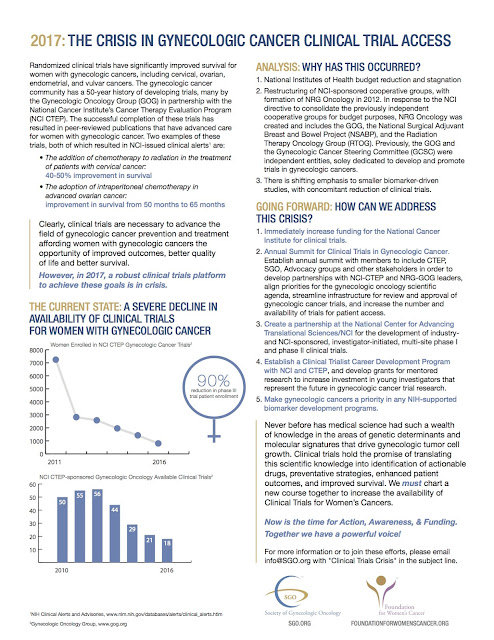
T5: Per @SGO_org, there is a crisis in gyn cancer trials. How can #gyncsm support research and encourage participation in #clinicaltrials?

We appreciate the insights and knowledge of those who participated in tonight's chat. And we hope as a community we will continue to educate women and their caregivers about clinical trials.

Additional resources from the chat are shared below. 

We hope you will join us on November 8, 2017 at 9:00pm EST for our chat on Endometrial and Uterine Cancers. See you then.  

Dee
#gyncsm Co-founder

RESOURCES:

Video | Understanding Gynecologic Cancer Clinical Trials from @GYNcancer
https://www.youtube.com/watch?v=UFGb8nQkE8c&feature=youtu.be

Understanding Clinical Trials - Your Guide from @GYNcancer
http://www.foundationforwomenscancer.org/wp-content/uploads/FWC-Clinical-Trials-Your-Guide-Brochure-web_updated.pdf
 
Diversity in Trials 
http://www.cancertodaymag.org/Summer2017/Pages/A-New-Look-for-Clinical-Trials-Diversity.aspx

ASCO guide: new trial designs & precision medicine
http://www.asco.org/research-progress/clinical-trials/clinical-trial-resources/clinical-trial-design-and-methodology

ASCO Broadening Trial Eligibility Criteria to Make Clinical Trials More Representative
http://www.asco.org/research-progress/clinical-trials/clinical-trial-eligibility-criteria 

Designing trials for adolescents 
http://www.cancertodaymag.org/Summer2017/Pages/More-Options-for-Adolescents-in-Clinical-Trials.aspx

NCI-MATCH info
https://www.cancer.gov/about-cancer/treatment/clinical-trials/nci-supported/nci-match

TAPUR
https://www.tapur.org/

About TAPUR on @cancerdotnet 
http://www.cancer.net/navigating-cancer-care/how-cancer-treated/clinical-trials/what-tapur-study

The National Quality Forum report on PROs
https://www.qualityforum.org/Projects/n-r/Patient-Reported_Outcomes/Patient-Reported_Outcomes.aspx

Patient Safety in Clinical Trials | Video by @theNCI 
https://www.youtube.com/watch?v=y7TDwbrD7GQ&feature=youtu.be

Patients’ willingness to participate in clinical trials
https://www.ncbi.nlm.nih.gov/pmc/articles/PMC4706669/

Physician and Patient Participation in Cancer Clinical Trials
https://www.ncbi.nlm.nih.gov/books/NBK220370/

Friday, October 6, 2017

Oct 2017 Chat: #clinicaltrials - How Have They Changed

While we have mentioned clinical trials in a few of our recent chats, we have not devoted an entire chat to the topic since 2014. On Wednesday October 11, 2017 at 9pm ET (8pm CT, 6pmPT) we will chat about "#clinicaltrials - How Have They Changed". 


We are happy that ASCO TAPUR Study Administrators will be joining us to discuss the TAPUR Study and how it differs from traditional trials.

Our topic questions are:

T1: What role do #clinicaltrials play in cancer treatment advances? What are some of the key trial design changes in the past 5 yrs?

T2: What is TAPUR? Why did @ASCO develop this trial? Who can participate? What makes TAPUR different from other trials?

T3: What are Patient Reported Outcomes (PRO)? What progress have you seen on ensuring that trials meet patients' needs/interests? 

T4a: Have you been involved in a #clinicaltrial? 
T4b: If yes, what benefits or drawbacks did you experience? If no, what were some of the reasons? Were trials offered to you? 

T5: Per @SGO_org, there is a crisis in gyn cancer trials. How can #gyncsm support research and encourage participation in #clinicaltrials?


In preparation for the chat, you can review this Clinical Trials : Your Guide brochure:  

http://www.foundationforwomenscancer.org/wp-content/uploads/FWC-Clinical-Trials-Your-Guide-Brochure-web_updated.pdf

or view this video provided by the Foundation for Women's Cancer:


Please also see this fact sheet on the Gyn Cancer Clinical Trials Crisis:

https://www.sgo.org/wp-content/uploads/2012/09/SGO-Clinical-Trial-Crisis-FINAL.pdf

We look forward to seeing you on Wednesday the 11th at 9pmET!

Dee
Co-Founder #gyncsm

Related #gyncsm Chats
Clinical Trials Part 1 - 11/2013
Clinical Trials Part 2 - 2/2014