Thursday, June 3, 2021

Gyn Cancer Research News - #SGOmtg - #ASCO21


It is our pleasure to once again share with our community the latest gyn cancer research news from the SGO Annual Meeting (#SGOmtg) and the ASCO Annual Meeting (#ASCO21). SGO is the Society for Gynecologic Oncology and ASCO is the American Society of Clinical Oncology. Both of their annual meetings were once again held virtually due to the COVID-19 pandemic. 

On June 9, 2021 at 8pm ET (7pm CT, 5PM PT), we invite you to join us as we review some of the latest research and discussions related to gynecologic cancer screening, treatment and research.  We may touch upon secondary surgery, PARP inhibitors, immunotherapy, rare ovarian cancer treatments, early detection and trials with negative results. Each annual meeting has/had several sessions on disparities in the treatment of gyn cancer which we will include in our topic questions. 

We will use these topic questions to guide our discussion

T1: 
What #SGOMtg presentations did you personally find of most interest?
Anything practice-changing to note?

T2: 
There was a session at #SGOmtg entitled "Time to Return to the Drawing Board: Learning From Negative Trials." 
What are "negative" trials and what are some key take-aways?   

T3: 
Which #ASCO21 studies do you think may be of most interest to patients?

T4: 
What are some of the "hot topics" in gynecologic cancer research currently ( PARPs, cytoreductive surgery, immunotherapy, other)? What is still up for debate that patients/survivors/advocates should be aware of?

T5:
Are there recent studies surrounding palliative care, survivorship, and psychosocial research that could help gyn cancer survivors? 

T6: 
Both #ASCO21 and #SGOmtg held sessions on disparities in gynecologic cancer care. What was highlighted and how can we work to decrease disparities?

T7: 
For remaining time, please feel free to ask questions about or highlight other recent research you find of interest. What studies are on the horizon? What areas would you like to see more research?

We look forward to having you join us. 


Dee and Christina

Co-founders #gyncsm Twitter Community

Wednesday, May 12, 2021

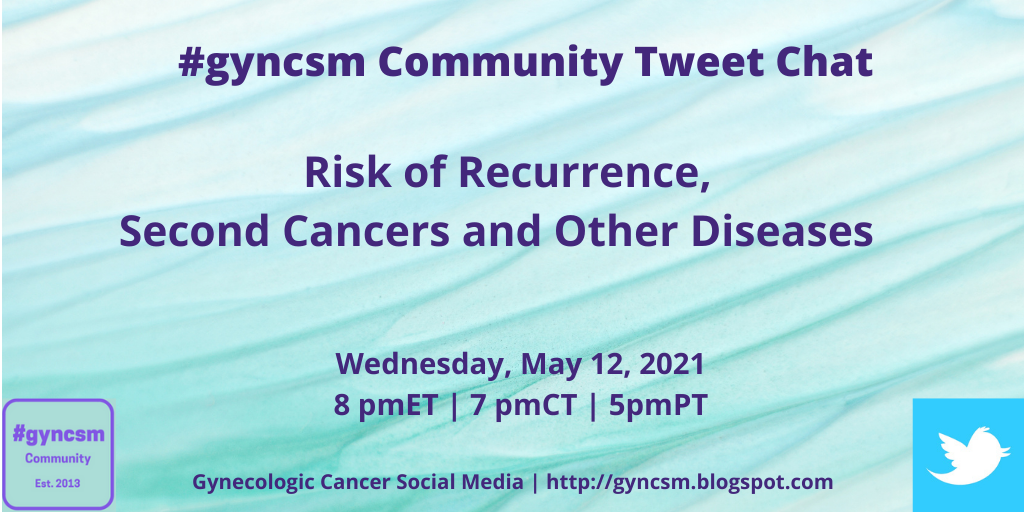
May 12, 2021 Risk of Recurrence, Second Cancers, and Other Diseases #gyncsm Chat

The #gyncsm community discussed Risk of Recurrence, Second Cancers, and Other Diseases for those diagnosed with a gynecologic cancer on May 12, 2021. We had twenty-six participants and 1.330 Million impressions - see more analytics here and you may read the transcript here.

Some highlighted Tweets from the chat may be found below each question. You will also find resources listed at the bottom of this post.

T1: What is the risk of recurrence for the main types of gynecologic cancer? Which gyn cancers have the highest recurrence risk?

  • According to @CancerCenter "An est. 35% of patients w/invasive #cervicalcancer develop persistent/recurrent disease following treatment. The recurrent cervical cancer rate is lower for those w/ early-stage disease. Most recurrences occur within 2 years of treatment."
  • The recurrence rate for #ovariancancer is very, very high. It can be hard to talk about with patients - and some don't want to think about it - but it also surprises too many that didn't get an open discussion after initial treatment 
  • Endometrial - recurrence rates for patients with early-stage disease range from 2–15% and reach as high as 50% in advanced stages or in patients with aggressive histologic condition. (70-100%) recurrences occur within 3 years after primary treatment from a 2011 study
  • vulvar cancer - Most recurrence occurs 2 years after treatment in women with inguinal lymph node involvement (32.7%) versus those without (5.1%). #gyncsm
  • Ovarian cancer has the highest recurrence rate overall -85% (occurring in 25% of patients with early-stage disease and >80% of patients with advanced disease.) 
  • There are many variables to consider (tumor stage & subtype, initial treatment, if there were tx breaks). For instance, cervical cancer is more likely to not recur if chemoRT is completed within 8 wks of starting.

T2: What is known about reducing one's risk of recurrence? How are cancer survivors monitored for gyn cancer recurrence?

  • Follow-up care is imperative for preventing recurrence of #cervicalcancer. That includes exams, imaging, and blood work. Exercise and diet may help along with smoking cessation.
  • I have heard that exercise may be beneficial in lowering one’s risk of recurrence
  • There are only so many things that one can control when trying to reduce risk. Some things we know - Find a way to be active that works for you. Stop smoking. Lots unknown. A long-term study in AZ was looking at eating, activity and more for ovarian cancer survivors.
  • While we all want to be in the group that never recurs, I think it's important to let people know the possibility. Nothing stops the shock of actual recurrence, & living in fear is hard - to be sure - but since it's likely with #ovariancancer, facts are important.
  • Survivorship plans are important for continued monitoring after initial diagnosis. The balance is listening to your body and getting things checked out without freaking out.
  • I know I was told very clearly by my first gyn Onc that I had no chance of recurrence, but here I am 4x later. I just hope everyone knows the possibility honestly. #gyncsm
  • T2 monitoring for recurrence: Regular exams; education about symptoms to report; routine imaging not always indicated but depends on individual plan; tumor markers if appropriate. Consuder for Surveillance plan - individual pros and cons/ patients preferences
  • I think survivorship plans are very important its been 10 years since my diagnosis and hardly any of my physicians followed mine because I had endometrial cancer they didn't think it was important after the hysterectomy. If only they knew 
  • Kind of back to preventing recurrence. But what treatment we get initially, if we have a gynonc (or not), & what type of surgery can all matter as well.
T3: Many cancer survivors report that fear of recurrence impacts their survivorship. What are some tips for dealing with the fear of recurrence?
  • We have so many great nuggets of advice on our blog (search for recurrence). A few are "Know your existence," "Own your story," Set boundaries, ask for help, journal it out, and take care of your mental health. https://t.co/25m45zv2WD #cervivor
  • walking my dog always keeps me chill & works for me…. We both enjoy it
  • There are some good resources - videos, podcasts, literature - about dealing with the fear of cancer recurrence because so many experience it. Know you are not alone. #gyncsm one via @CancerDotNet https://t.co/aFzmrUlrrP
  • Latino cancer survivors face a tough journey. Our leader, Dr. Amelie Ramirez of @UTHealthSA, is helping launch a 6-year @theNCI study to find new ways to help Latino cancer survivors heal, recover, and stop cancer from returning!
  • I think the most important thing is to show those of us who LIVE with multiple recurrences and still make a positive impact and have a happy life! It’s tough, but I’m much better off than those frozen in fear! 
  • Incredibly important to address! Any plans for education and surveillance we add as MD we should be recognizing how this creates anxiety! and really should be coupled with how to get resources on coping, normal expected anxiety...
  • Here is the facebook page for Survivor Slimdown https://t.co/tVeEbxSI3N
T4: What are some of the secondary cancers that those with a gynecologic cancer should be concerned about? What is the role of genetics and family history? What about secondary cancers related to treatment?
  •  We can still get cancers that others get. According to @AmericanCancer, #cervicalcancer survivors are at higher risk for: mouth/throat, larynx, anal, vulvar, vaginal, lung, bladder/ureter, stomach, colorectal, pancreas, and acute myeloid leukemia.
  • As we learn more and more about genetics, we learn more about what caners are connected and run in families. Know your family history if you can. See if multi-gene testing is advised as more is known.
  • From @EKing719 in women who have had Hpv-related gyn malignancies there is a risk of anal cancer . Check @FarrahFawcettFN https://t.co/DPVvvpaqzF and at https://t.co/bheTVoAKCu
  • There have been conflicting study results but generally we don't think that radiotherapy increases your risk of rectal cancer for instance. In rare instances, you can develop sarcoma about 10 years after radiotherapy.
  • for basics also making sure survivors keep up with screening depending on phase in cancer care and age re #breastcancerscreening #colorectalcancerscreening #lungcancerscreening // know family history// refer for genetic counseling!!
  • those of us with genetic mutations have to deal with risk of getting yet another cancer and decisions on how to prevent that
  • HNPCC or Lynch Syndrome While HNPCC poses the greatest risk of colorectal cancer, women with HNPCC have about a 12 percent lifetime risk of developing ovarian and a 40-60 percent chance of developing uterine cancer.” https://t.co/QbGQXoXRD5
  • Ran across this while doing chat prep: Meta-analysis and retrospective pharmacovigilance study of MDS and AML in patients receiving PARP inhibitor treatment https://t.co/LXHXHi7T6K
  • It can be heavy to talk about all the additional risks, but like someone said, knowledge can help one deal with the fear and not be blind-sideded if something does come up.
  • Very important point! Important to know for patients who on your medical team can best help quarterback getting appropriate tests scheduled, ordered up to date etc- sometimes gyn onc or med onc or PCP or cancer genetics team . @FacingOurRisk - great resources here!
T5: Are there other physical and mental health conditions that being diagnosed with and treated for gynecologic cancers increase the risk of experiencing?
  • many already have a list of conditions prior to cancer. This just adds to the pile. Can be hard to assess what is causing what.
  • PTSD is often experienced in our community from internal radiation. It may take someone years to process through the emotional toll - as for physical, there are various side effects from lymphedema, infertility, osteoporosis, gastrointestinal issues, etc.
  • For women who were younger who went into surgical menopause due to surgery, this can create many physical & psychological issues.
  • Issues related to sexual function; chronic changes in urinary and GI function after surgery, chemo and or RT.; early referring to physical therapy, urogyn, GI nutrition.... need to ask and talk about even if no easy answers.
  • In my own situation it has increased my anxiety and depression at times especially in regards to my infertility.
  • Confounding this is that the rate of #ovariancancer is higher in those who have had #PTSD prior to diagnosis. And, we know from the #ACEs study, those of us with trauma in childhood have increased risk of many diseases, including cancer.
  • one of my concerns are potential cardiac issues due to cancer treatment combined w surgical menopause.
T6: What impact does having had cancer have on risk for and severity of COVID-19 and other non-cancer related diseases?
  • Most research shows that having cancer increases your risk of severe illness from COVID-19. Other factors include a weakened immune system, older age, and other medical conditions.
  • you can find resources at @GYNCancer site https://t.co/fvRX6dpubK

We end our chats with Today I Learned (TIL) . Here is a TIL from tonight's chat. 
TIL: Hard conversations are... hard. But let's not avoid them. Cancer stories are not all "inspirational/positive" but they are all important and provide so much value. Thanks to all who share their cancer truths.

We look forward to you joining us at the next #gyncsm chat on Wednesday, June 9, at 8pmET (new time for 2021) when we’ll discuss “GYN Cancer Research News” from #SGOMtg and #ASCO21

Dee and Christina
#gyncsm Co-Founders
 

Resources 
@AmericanCancer - Can I Do Anything to Prevent Cancer Recurrence?
https://www.cancer.org/treatment/survivorship-during-and-after-treatment/understanding-recurrence/can-i-do-anything-to-prevent-cancer-recurrence.html

HealthDay - Obesity And Overweight Associated With Increased Risk Of Developing Several Types Of Cancers 

@sloan_kettering MMSKCC - 6 Tips for Managing Fear of Recurrence

Meta-analysis and retrospective pharmacovigilance study of MDS and AML in patients receiving PARP inhibitor treatment  

Ovarian Cancer Patients at Higher Risk for Mental Illness  


@GYNCancer - Covid resources

Post-treatment surveillance and dignosis of recurrence in gynecologic malignancies - SGO recommendations  

American Cancer Society - Second Cancers after Endometrial Cancer 
 
@CancerDotNet - Heart Problems

Thursday, May 6, 2021

Risk of Recurrence, Second Cancers and other Diseases 5/12/21 Chat


This month on Wednesday, May 12, 2021 at 8pm ET, the #gyncsm community will discuss Risk of Recurrence, Second Cancers, and Other Diseases among those diagnosed with a gynecologic cancer. 

Recurrence can be a tough subject that sometimes isn't adequately addressed following initial diagnosis and treatment. Yet, depending on the stage at diagnosis, we know that recurrence is an issue survivors deal with frequently. We will discuss what is known about reducing the risk of recurrence, monitoring for recurrence, and addressing the impact of the fear of recurrence. The risk of second cancers, especially for those with a genetic risk, will also be discussed along with the risks of other health conditions that can come with treatment for gyn cancers. We will finish our chat discussing the impact of Covid19 infection and other illnesses among women with a gyn cancer, including mental health issues.

We will use the following Topic Questions (T:) to guide our discussion:

T1: What is the risk of recurrence for the main types of gynecologic cancer? Which gyn cancers have the highest recurrence risk?

T2: What is known about reducing one's risk of recurrence? How are cancer survivors monitored for gyn cancer recurrence?

T3: Many cancer survivors report that fear of recurrence impacts their survivorship. What are some tips for dealing with the fear of recurrence?

T4: What are some of the secondary cancers that those with a gynecologic cancer should be concerned about? What is the role of genetics and family history? What about secondary cancers related to treatment?

T5: Are there other physical and mental health conditions that being diagnosed with and treated for gynecologic cancers increase the risk of experiencing?

T6: What impact does having had cancer have on risk for and severity of COVID-19 and other non-cancer related diseases? 


We hope you can join us,

Dee and Christina


Wednesday, April 14, 2021

OCRA Community Partner

Since early in our history as a community for those impacted by gynecologic cancer, the #gyncsm community has been an Ovarian Cancer Research Alliance (OCRA) Community Partner. You can learn more about Community Partners here. 

We thought it important to share this What You Need to Know About Ovarian Cancer graphic with all of you.  Feel free to share with others. 


Just a reminder, there will be no #gyncsm chat this month. Save the date for our next chat Wednesday, May 12, 2021 at 8pmET (new time for 2021) when we’ll discuss “Cancer Survivors: Risk of Recurrence and Other Cancers/Diseases”.


Dee

Wednesday, March 10, 2021

March 10, 2021 Disparities in Gyn Cancer Diagnosis and Treatment

The #gyncsm community welcomed Dr. Dineo Khabele (@DKhabeleMD), Washington University School of Medicine gynecologic oncologist to this month's chat on Disparities in Gyn Cancer Diagnosis and Treatment. Advocates, researchers and health care providers participated in our important discussion. 

Here is a sample of the responses to our topic questions.  You may read the complete transcript here and additional analytics here. 

T1: What are cancer disparities? What factors can contribute to cancer disparities? 
  • Disparities range from race or ethnicity, to location, to age, gender identity, socioeconomic status, disability, insurance coverage, etc. All of these and more contribute to cancer care.
  • Cancer disparities are differences in the incidence, prevalence, and mortality among specific populations. Contributing factors are social determinants of health, healthcare systems, and discrimination. 
  • "Cancer affects all population groups in the United States, but due to social, environmental, and economic disadvantages, certain groups bear a disproportionate burden of cancer compared with other groups." NCI
  • Don't forget the rarity of the cancer. Rare cancers, including gyn ones, generally get less funding for research and support services. #sarcoma
  • “Your zip code matters more than your genetic code.”
  • Society, financial, ethnicity, geography, gender identity.... So many people don’t get the care they need and deserve.

T2a: What are some of the cancer disparities that show up in the diagnosis of gynecologic cancers? 
T2b: What are some of the cancer disparities that show up in the treatment for gynecologic cancers?
  • African Americans are more likely than Caucasians to be diagnosed with regional or distant stages for most cancers. Hispanic women are 40% more likely to receive a #cervicalcancer diagnosis. Asian Americans are at 5x the risk! 
  • Black women and Latinas are more likely to be diagnosed with advanced stage disease.
  • per @theNCI the incidence rates of colorectal, lung, and cervical cancers are much higher in rural Appalachia than in urban areas in the region.
  • Lack of access to follow up for an abnormal Pap test or abnormal uterine bleeding also contributes to delays in diagnosis.
  • We know African American women are DYING at 2x the rate as their Caucasian peers. We also see disparities in the stigma attached to an HPV-related cancer, gender identification, socioeconomic status, and location, location, location
  • Black women are less likely to be operated on by a high-volume surgeon or to be offered clinical trials. This leads to worse outcomes.
  • mentioned in the @AACR Cancer Progress Report: "African American and Hispanic patients with early-stage cervical cancer are more likely to forgo surgery, which is the standard of care, compared with white patients (17% and 12% vs 9% respectively)"
  • In #gyncsm care especially, high-case volume and gyn-onc specialists have statistically better outcomes. So the disparities in access and overall can really hit hard.

T3: Studies have found African-American women experience higher mortality from #endometrialcancer than any other group of women. What factors are researchers looking into to explain and address this disparity? 
  • Endometrial and cervical cancer have some of the largest racial disparities among all cancer disease sites. This may be partly due to the double whammy of poor quality care for patients who are WOMEN and BLACK.
  • Black women (not just in the U.S.) are more likely to be diagnosed with uterine #sarcoma, which tends to be more aggressive than endometrial carcinoma.
  • @KemiDoll is a leader in this field. Racism is a driving contributor to poor outcomes in #endometrialcancer.
  • although endometrial cancer disparities for decades were assumed to be related to genetics @KemiDoll brilliantly demonstrated how care for Black women with #endometrialcancer is delayed.
  • It is great to see researchers leading the way into figuring out the disparities in endometrial cancer and groups like @ECANAwomen who are supporting the research and the women.
  • Multiple factors. Some I think about 1) delays in diagnosis and work up of abnormal bleeding 2) inadequate or no surgery 3) biases affect adjuvant therapy recommendations or uptake 4)% higher high risk histology— we need more work there!
  • Decades and billions of dollars of funding have shown these are not genetic difference. The healthcare system needs to re-evaluate how we have failed women who are Black with #endometrialcancer
  • Historically, People of Color were not represented equitably and statistics show: African Americans are 13% of US Population but only 3% in oncology trials, Hispanics 19% of US Population but only 6%. Disparities can be minimized with health equity and access to care.

T4: American Indians and Alaska Natives have higher incidence and mortality rates for cervical cancers and higher mortality for uterine cancer. What role does future research play in addressing disparities such as these?
  • Racism in healthcare delivery is a huge problem. We’ve been looking at the lit and many researchers have found that implicit bias and anti-radicals training is desperately lacking in healthcare education
  • We need to bring screening to their location and programs to reduce risk https://www.cdc.gov/cancer/dcpc/research/articles/cancer-AIAN-US.htm
  • Groups like @AICAF_Org are working in native communities to address cancer disparities. Research for gyn cancer is already on the low side. Then add that the treatment studies are mostly caucasian participants and you can see the challenges.
  • We need more research in these communities about the experience of women diagnosed with the cancers too to understand the missed opportunities best. I suspect issues of access to health care system and delayed work ups contribute
  • T4: Serious kudos to Amanda Bruegl, M.D. who is a great resource on disparities related to gyn cancer in Native Americans. She has been looking at HPV vaccine uptake, access to care and historical disenfranchisement as causative of poor outcomes in #cervicalcancer.
  • Similar to other marginalized and minoritized groups, social determinants of health are the main drivers for these disparities in Native American communities. We need to involve affected communities in research and care.

T5: What are some population groups beyond racial and ethnic minorities for which cancer disparities in the U.S. exist?
  • People with disabilities typically have lower cancer screening rates than people without disabilities. They face barriers like transportation, wait time for appointments, and difficulty getting to an appointment.
  • Lower screening rates are also seen in the LGBTQ+ community. Common barriers include fear of discrimination and lack of information. It is important to "screen the body parts you have.
  • Individuals from the LGBTQ+ community experience cancer disparities due to structural discrimination and social determinants of health. For example, transgender men with a cervix are less likely to receive cervical cancer screening tests.
  • The rural/urban disparities are pretty stark with gynecologic cancer. There are also age disparities - some due to "too young for cancer" thinking.
  • Remote geography decreases access to care. #gyncsm. We need to partner community healthcare with larger health care systems.
  • The issue of bias against women influences all the care that women with #gyncsm receive. The cancer center's focus is rarely gynecologic. Funding for gyn cancers is disproportionately low. Gynecologic oncologists are under-represented in healthcare leadership.
  • We can include underinsured / uninsured, and language barriers to our groups too.
  • Rural and urban disparities have to do with lack of access to quality care. Agree with age myths. We are diagnosing endometrial cancer at younger ages.  
  • Transportation is a huge barrier. Rural patients and caregivers struggle to make it to appointments, pay for gas, take time off of work.

T6: What are some resources and groups helping to address disparity and equity issues? How can advocates help to reduce gyn cancer health disparities in our own communities?
  • We [Cervivor] are here for anyone diagnosed with #cervicalcancer. For LGBTQ resources: @cancerLGBT For People with Disabilities: @CancerLegalHelp We believe sharing your story matters. You have the power to shift the narrative!
  • Patient Advocates should center marginalized voices! Surround yourself with patients from diverse backgrounds as much as you can to understand the different challenges and complexities.
  • Resources @GYNCancer @SGO_org. Advocates can raise awareness in their communities, become research advocates, and lobby for more funding for research and care.
  • we need to make policy changes @ACSCAN has a chartbook and is working on policy https://t.co/INVqSyfYVF
  • Talk with your nurse, your doctor and your care team. Local resources may often be the best resource for patients. Eliminating inequities begins locally, extend regionally and gains traction nationally.
  • @SGO_org recently made this joint statement https://www.sgo.org/news/joint-statement-collective-action-addressing-racism/
  • More on the survivorship aspect, but sharing information about the side effects of treatment may help lessen disparities due to lack of treatment toxicity support A good organization for pelvic radiation from the UK is @PRDA_uk
  •  If you’ve never seen it the classic documentary Southern Comfort is an excellent watch for those of us who care about disparities in Gyn Cancer. https://transguys.com/videos/southern-comfort
  • While social determinants of health play a great role in #healthdisparities, there is evidence that health professionals themselves contribute to health disparities through non-inclusive medical processes and biased interventions.
  • And these community partnerships would be incredibly beneficial to cultivate BEFORE screening/diagnosis. Meeting people where they are for community health education PRIOR to a time of need can help reduce disparities down the road.
  • Groups like @IamCervivor @ECANAwomen @ucan2020 @SHAREing are doing excellent work. I'm missing many so if you are working in the space of disparities, please let me know.  


Note: There will be no #gyncsm chat in April. Save the date for our next chat Wednesday, May 12, 2021 at 8pmET (new time for 2021) when we’ll discuss “Cancer Survivors: Risk of Recurrence and Other Cancers/Diseases”.

Stay Safe,

Dee 


Additional Resources Shared

Geographic disparities in the distribution of the U.S. gynecologic oncology workforce: https://www.ncbi.nlm.nih.gov/pmc/articles/PMC5699889/

Palliative care: Racial and ethnic disparities in palliative care utilization among gynecological cancer patients https://www.sciencedirect.com/science/article/abs/pii/S0090825820341597


Thursday, March 4, 2021

Disparities in Gyn Cancer Diagnosis and Treatment - March 10, 2021 Chat

We are grateful that joining us for this month's chat on Disparities in Gyn Cancer Diagnosis and Treatment will be Washington University School of Medicine, gynecologic oncologist Dr. Dineo Khabele (@DKhabeleMD). The chat will be  held on Wednesday, March 10, 2021 at 8pm ET (7pm CT, 5pm PT) which is our new time slot.

Using the following topic questions we will discuss factors that contribute to health care disparities in general and gyn cancer disparities in particular and examine what organizations and health care systems are doing now to reduce disparities and what role advocates can play in addressing disparities in our communities.

T1: What are cancer disparities? What factors can contribute to cancer disparities? 

T2a: What are some of the cancer disparities that show up in the diagnosis of gynecologic cancers? 
T2b: What are some of the cancer disparities that show up in the treatment for gynecologic cancers?

T3: Studies have found African-American women experience higher mortality from #endometrialcancer than any other group of women. What factors are researchers looking into to explain and address this disparity? 

T4: American Indians and Alaska Natives have higher incidence and mortality rates for cervical cancers and higher mortality for uterine cancer. What role does future research play in addressing disparities such as these?

T5: What are some population groups beyond racial and ethnic minorities for which cancer disparities in the U.S. exist?

T6: What are some resources and groups helping to address disparity and equity issues? How can advocates help to reduce gyn cancer health disparities in our own communities?

You can find an overview on the topic of Cancer Disparities from the National Cancer Institute at https://www.cancer.gov/about-cancer/understanding/disparities

Professional organizations in obstetrics and gynecology, including the SGO, have issued a Joint Statement of Collective Action Addressing Racism. The statement includes actions that can be taken - Collaboration, Education, Recognition and Scholarship, Inclusion, Caring for Patients, Policy and Advocacy. You may read the statement at https://www.sgo.org/news/joint-statement-collective-action-addressing-racism/

We hope you can join us in this important discussion. 

Dee and Christina
#gyncsm Co-founders 

PS: Don't forget the SGO Meeting (#SGOMtg) Virtual Meeting takes place from March 19-25. Register at https://www.sgo.org/events/annual-meeting/

Wednesday, February 10, 2021

February 10, 2021 Communication and Support Chat

We were happy so many in our community could join us for our first chat of 2021. Communicating With Your Health Care Team and Asking For Support drew twenty-seven participants from the US and internationally, too. You may find the transcript here and analytics here. 

Here is a small sample of the responses to our topic questions. 

T1: How would you describe what constitutes good communication with your health care team?

T1 Good communication means multi-discipline coordination, collaboration, and decision making to include the patient, innovation, and caregivers.

T1: Allowing time for questions & being responsive to questions. Getting results in a timely manner.

Our @CancerHopeNet survivors often tell me that it's critical they're communicating WITH their team, not just being dictated to (intentionally or unintentionally). Respect for personalities, beliefs and cultures is critical.

T1: Feeling heard and seen. Feeling understood. Would be amazing to feel that coordination would happen between different doctors/specialists/pharmacies with burden not all on patient for care coordination

From physician perspective, overall goals are explained at a patient centered level, daily goals are discussed with nursing staff, residents have clear idea of plan, and most important the patient feels heard and at the center of it all

T1: Good communication involves not just listening but also taking nonverbal cues from patients during the conversation. It's also very important for patients to feel comfortable asking questions to their attending and go home with a clear understanding of the situation

T2a: How has communicating with your team changed during your cancer experience?

T2: It’s been less frequent. I recently transitioned to the Nurse Practitioner. Feeling a little disconnected. Grateful to be where I am though 

T2 A I learned to not be shy and speak up and ask for things and that helped my team know what I needed help with.

T2: I think at first you don't know what questions to ask. I think that is when hearing from your doctor about patient organizations and peer support might best help. Many have a "list of questions" and FAQs. Getting that info early can help guide what to ask dr. 

T2: I haven't tried any telehealth appointments yet, but I hope they are here to stay where they make sense. i.e. that insurance will keep covering... 

T2b: Has communication between you and your healthcare team been impacted by the Covid-19 pandemic?

T2bCOVID has added such a layer of complexity to good communication! Everyone is so stretched when you call it's hard to get to the right person and if someone calls back you're repeating your story over and over or clearing up misunderstandings. 

T2b. #gyncsm this hasn’t impacted me directly: but those in my life have had repeat treatment paused. Difficult to get hold of consultant but nurse team been great

T2b: I think that telemedicine now plays a bigger role in patient consultations, but where I come from it's not readily accessible to all. And now, you have to be extra observant with patients' eye expressions since that's all you can see.

T3: Have you discussed clinical trials with your provider? How was that information communicated? Did you bring up trials or did your provider?

T3 Physician recommendation is the most important factor in patients decisions to enroll onto a #clinicaltrial. If your doctor doesn't discuss this option consider asking and/or getting a second opinion.

T3: It is tough to squeeze lots of stuff into appointments and small communication outside of appointments. Clinical trials and supportive care and side effects - so much beyond treatment to ask about and plan out.

T3 @cure_magazine shared some insight into Why it is never too soon to ask about trials . https://www.curetoday.com/view/why-it-s-never-too-soon-to-consider-clinical-trials-as-a-treatment-option

T4: What would you suggest to your health care team or health care system that would improve communication? What would you suggest to patients to improve communication?

T4: to improve communication I would recommend that there is frequent communication between the gyn onc & med onc. I would recommend that doctors not be intimidated by patients who like to ask questions.

T4: I'll raise my hand and say I don't always "do my homework" and go into a medical encounter with clear goals about what I want to discuss or walk away with. I need to block some time between appts to focus.

T4. #gyncsm Get a patient advisory group / lived experience group together online and ask them how communication can be improved. #coproduction is possible even during #covid19

T4: I’d suggest asking patients what they want & need & making sure patient feedback is included in notes. Often what patient might define as an adverse event or not differs than medical team assessment. We need to record what patient’s say.

T4: @gyncsm My oncologist is often surprised I’m in groups with 100s to 1000s of other patients comparing symptoms, side effects, & treatments with people all over country & world. We are influenced by what other patients say about a drug, for ex., not just clinical studies

T4. Timely updates to patient records and a patient survey immediately after a visit. I'd also ask that teams not see innovation as the enemy of coordination.

T4: I think spacing out appointments has helped me give enough time for each patient consult so that I can still answer questions. I also tell my patients to list down things they forgot to ask and tell me on the next visit. 

T4: Also, I appreciate it when patients ask me about what they find on Google rather than acting on these info directly and possibly getting into harm's way. More and more patients are on the Internet and doctors should be prepared to handle these "external" info. 

T5: What is the best advice you have received to communicate your need for support - emotional or physical - with your health care team?

t5: That’s a tough one. I think in life, I’ve always been a fighter. And I also want to understand things. I’ve always advocated for myself and I think the best advice is to continue to always advocate for yourself. 

T5: #CervivorAmbassador Becky Wallace shared her advice in this blog post. cervivor.org/the-power-of-s… 

T5 #gyncsm That the National Health Service #NHS IS STILL OPEN during #covid19 don’t delay if you have any concerns

T6: How do you prepare for visits with your health care team?

T6 I keep a medical journal. My prep includes writing down questions, asking about meds, and general health questions if I've noted any adverse reactions.

t6: I keep a running “note” in my phone for my next appointment. I list any questions that I would like answered or any issues I’ve been having so I don’t forget to mention. #gyncsm 

T6: Keep a notebook and write down questions in between appointments so you don't forget them. Ask who is on your team and write their info. My little notebook was filled by the time I finished 9 cycles. Ask for copies of all test results. which could lead to more ?'s. #gyncsm

Questions! Questions! Lists of things I need to remember to ask.

We end out chats with TIL standing for Today I Learned. Here are just a few examples from tonight's chat. 

TIL Good communication between the patient and the healthcare team is one of the keys to effective care delivery and patient satisfaction. It's a crucial area that should be actively worked on by all stakeholders. #gyncsm

til: How doctors have been impacted by COVID & how it’s been more difficult to “read” patients & make sure they are heard. 

TIL #gyncsm made me remember how important #PeerSupport is right now


Christina and I look forward to seeing you at the next #gyncsm chat on Wednesday, March 10, 2021 at 8pmET when we’ll discuss “Disparities in Gyn Cancer Diagnosis and Treatment”. See you all then!

Dee 
#gyncsm Co-founder
 
 
Related Reading:
ASCO Patient Clinician Guideline 

@canceradvocacy Survivorship Toolbox-Communication
https://canceradvocacy.org/resources/cancer-survival-toolbox/communicating/

@NPAF_tweets Skilled Communications in Shared Decision Making: A Tool Kit for Health Care Providers and Advocates
https://www.npaf.org/patients-and-caregivers/skilled-communications/

Assessing communication tool @RTI_Intl for researchers physicians
Researchers have found a link between PCC and greater patient satisfaction, treatment adherence, and quality of life. https://www.rti.org/impact/patient-centered-communication-cancer-care-instrument

OC survey Reveals Need to improve patient-provider communication
Resources before during and after appointments:
https://www.ourwayforward.com/ovarian-cancer-support-and-resources/communicating-with-hcp-team

Our Way Forward Survey Results
https://www.oncnursingnews.com/view/ovarian-cancer-survey-reveals-need-to-improve-patientprovider-communication
Our Way Forward - https://www.ourwayforward.com/

Nurse / patient communication
https://www.oncnursingnews.com/view/patient-nurse-communication-is-key-in-ovarian-cancer

Doctors need to talk to each other
https://conquer-magazine.com/issues/2020/vol-6-no-6-december-2020/1441-poor-communication-affects-patients-doctors-should-talk-with-the-patient-and-each-other

Telehealth
https://conquer-magazine.com/issues/2020/vol-6-no-3-june-2020/1284-telehealth-can-help-patients-with-cancer-during-covid-19-but-does-not-replace-in-person-treatments